Sections & materials
What a section and a material contribute to the stiffness matrix and the design checks, and the values worth checking twice.
Modeling 7 min read
A member is a line until it has a section and a material. Between them they supply every number the solver multiplies geometry by, and every number a design check divides a force by. This page lists those properties and what each is for, so a wrong one can be recognised, not merely suspected.
Define once, reuse everywhere
Sections and materials are definitions, held once in the project and assigned to
members by reference. Changing IPE 400 to IPE 450 in the definition changes every
member that uses it; nothing is redrawn and no member has a private copy that drifts. That
makes a late section swap a five-second operation, and it also repeats a mistake in one
definition everywhere it is used.
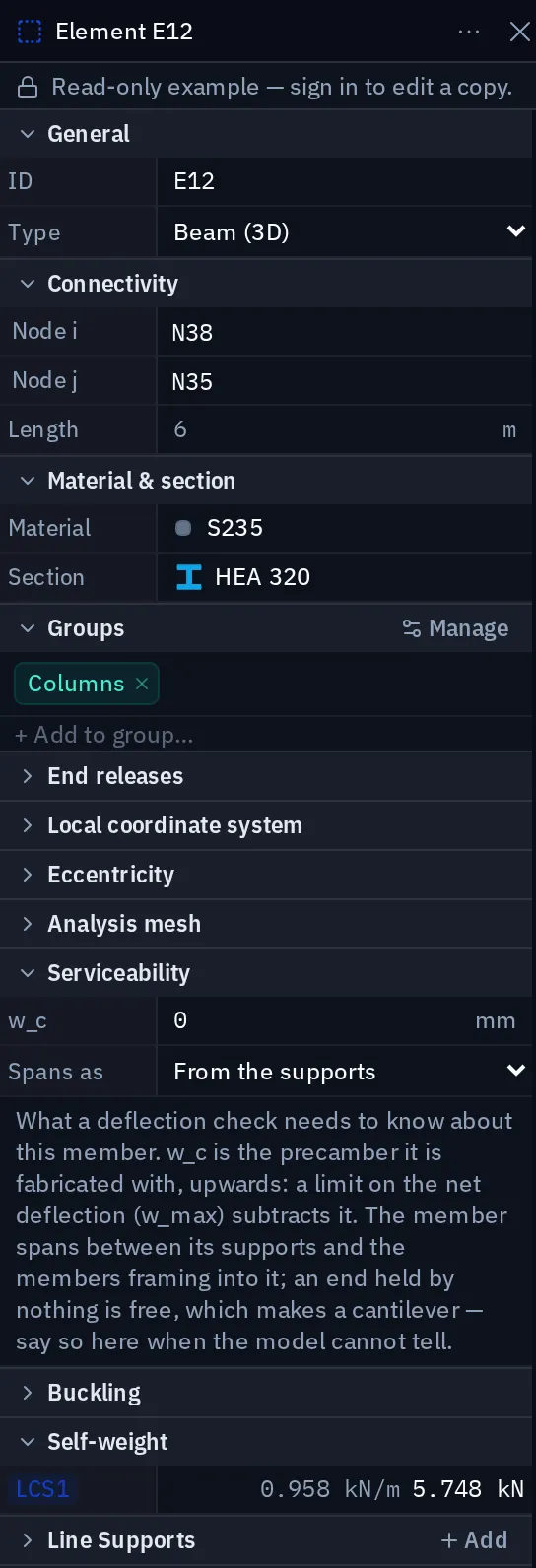
The properties panel edits the selection: select twenty members and assign a section, and all twenty take it.
What a section carries
| Property | Symbol | Used by |
|---|---|---|
| Area | Axial stiffness , self-weight, | |
| Second moments of area | , | Bending stiffness about each axis, buckling, deflection |
| Torsion constant | Torsional stiffness | |
| Shear areas | , | Shear deformation in the beam element; in the steel check |
| Elastic section moduli | , | Class 3 bending resistance, elastic stress |
| Plastic section moduli | , | Class 1 and 2 bending resistance |
| Outline dimensions | , , , , … | Section classification, rendering, eccentricities |
The first four are what the solver reads: with the material, they are the member's stiffness. The moduli and the outline are what the design checks read. A section with the right area and second moments but the wrong flange thickness will solve correctly and classify wrongly, a subtler failure than the reverse.
Axes
is the second moment about the section's local axis, which for an I-section in its normal orientation is the strong axis; is the weak one. pairs with and ; with and . Rotate a column ninety degrees about its own axis and the strong direction rotates with it, and the solver will not object. See Sign conventions.
The AISC module uses the same numbers under different names: the app's is AISC's . Steel — AISC 360 has the mapping.
Torsion
is the St. Venant torsion constant. The beam element carries St. Venant torsion only; warping restraint is not modelled. An open section under significant torsion (a channel loaded off its shear centre, a cantilevering I-beam with a twisting load) will report a lower torsional stiffness than a warping-restrained member really has, and the design checks say so instead of quietly using the wrong theory. Closed sections are barely affected, because their torsional stiffness is St. Venant.
Shear areas
The shear areas control shear deformation in the beam element and the plastic shear resistance in the steel check. For slender members shear deformation is negligible either way. Below a span-to-depth ratio of roughly ten it is not, and a stocky beam without shear areas comes out stiffer than it is. For rolled sections the code's own values are in EN 1993-1-1 §6.2.6(3). See Element formulations.
What a material carries
The library ships steel S235 to S690, ASTM A36, A572 Gr.50 and A992, three stainless grades, B500B reinforcement, concrete C12/15 to C90/105 plus the 4000 and 6000 psi grades, three EN AW aluminium alloys, and timber C16 to GL32h. A material not in it is added from the same panel with the properties below; only steel has a design module, so the rest are there for stiffness, mass and weight.
| Property | Symbol | Used by |
|---|---|---|
| Young's modulus | Every stiffness term | |
| Shear modulus | Torsion and shear deformation; for an isotropic material | |
| Poisson's ratio | Surfaces: the coupling between the two in-plane directions, and | |
| Density | Self-weight and the mass matrix for modal analysis | |
| Thermal expansion | Temperature loads | |
| Strength | , , , … | Design checks only |
Strength plays no part in the analysis. A linear elastic solve gives the same forces for S235 and S355; the difference appears only when a check divides by the resistance. This is why a linear result cannot tell you a member has yielded. See Linear static.
Values worth knowing by heart
| Material | |||
|---|---|---|---|
| Structural steel | 210 000 MPa | 0.3 | 7 850 kg/m³ |
| Concrete (EN 1992-1-1, C30/37) | 33 000 MPa, secant, uncracked | 0.2 | 2 500 kg/m³ reinforced |
| Aluminium | 70 000 MPa | 0.33 | 2 700 kg/m³ |
| Softwood timber, parallel to grain | 11 000 MPa, indicative | — | 400–500 kg/m³ |
Steel's yield strength changes with grade and thickness; its modulus does not. Concrete is where the modulus is a decision. The tabulated is a short-term uncracked value, and real deflections of a cracked, creeping slab are several times the linear elastic ones. The linear model reports the uncracked answer; the code's cracked-section and creep methods convert it. Read Linear static — where it is not enough.
Density and self-weight
Self-weight is generated from on members and on surfaces, so it is exactly as right as those three numbers. A material with zero density gives a model that solves perfectly and weighs nothing; a density typed in the wrong unit is off by a round factor — a hundred for kN/m³ typed where kg/m³ belongs, a thousand for t/m³.
Steel grades and thickness
EN 1993-1-1 Table 3.1 reduces the nominal yield strength of thicker plates:
| Grade | , mm | , mm |
|---|---|---|
| S235 | 235 MPa | 215 MPa |
| S275 | 275 MPa | 255 MPa |
| S355 | 355 MPa | 335 MPa |
| S460 | 460 MPa | 440 MPa |
Where the national annex refers to the product standard (EN 10025) instead, the steps are finer and the values slightly different.
Catalogue and custom sections
Five catalogues ship, all picked by name from the library:
| Catalogue | Contents |
|---|---|
| European hot-rolled profiles | I, H and U profiles to EN 10365 and angles to EN 10056 |
| American hot-rolled shapes | W, HP, S, C and MC shapes and angles to ASTM A6, metric designations |
| AISC shapes | The AISC Shapes Database v16.0: W, M, S, HP, C, MC, L, HSS and pipe, 1,329 shapes in US customary units |
| Russian hot-rolled profiles | GOST beams and channels |
| Hot finished hollow sections | Square, rectangular and circular hollow sections to EN 10210 |
Anything else is made in the section editor, which has four ways in:
- Parametric shapes from dimensions: rectangle, circle, pipe, box, I, tee, channel and angle. A plated girder is an I with your own flange and web sizes.
- Outline, drawn on the editor's canvas or read from a DXF. The properties are then solved on the drawn shape: by the St-Venant stress function on a finite-difference grid, the shear areas from the shear flow, so a custom shape gets real values rather than a thin-walled guess.
- Composite, several shapes placed together, for a built-up section.
- Generic, the numbers typed straight in, for a section whose properties come from a supplier's table and whose shape does not matter.
So anything with a known , , , and moduli can be a section: a plated girder, a built-up box, a timber glulam, a concrete rectangle. Two cautions:
- Classification. The EN 1993-1-1 module classifies doubly symmetric I and H sections and rectangular hollow sections from their outline, and treats solid rectangles and circles as Class 1. Anything else is verified elastically as Class 3, with a message saying so. See Section classification. That is conservative for a stocky custom shape and unconservative for a thin-walled one that is really Class 4.
- Consistency. is the shape factor: about 1.12 to 1.15 for an I-section about its strong axis, about 1.5 about its weak axis and for a rectangle, 1.70 for a solid circle. A plastic modulus below , or far outside the range for its shape, is a typing error.
Limits in this release
- The yield strength is not reduced for thickness. Every check uses the material's as entered; members with elements thicker than 40 mm need their own material at the reduced value (see Steel grades and thickness).
Checklist
- Every member has both a section and a material.
- is 210 000 MPa for steel, not 210, not 2.1.
- Density is in
kg/m³, and the self-weight reaction matches a hand estimate. - The strong axis points the way you think, on every rotated or sloping member.
- The yield strength matches the grade and the thickness.
- Stocky members have shear areas.
Something wrong or unclear on this page? Tell us, and it gets corrected.