Four worked structures, ready to open.
Each opens solved in the real editor, with no account and nothing to install. Press F5 and it solves again in your own browser.
Solve times are the linear static analysis as the editor measures it, on the second F5 after opening, in a browser on a 16-thread machine: 12 November 2026 on v0.8.2, the overpass on 5 November on v0.8.1. The status bar also counts an example's stability analysis. Every example opens solved, with all its design checks, on any plan; the caps apply only to a copy you save to your account with Make it mine. Open one, press F5 and read your own.
01 / 04 · start here
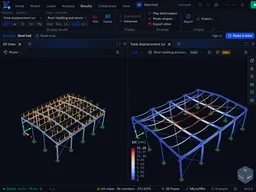
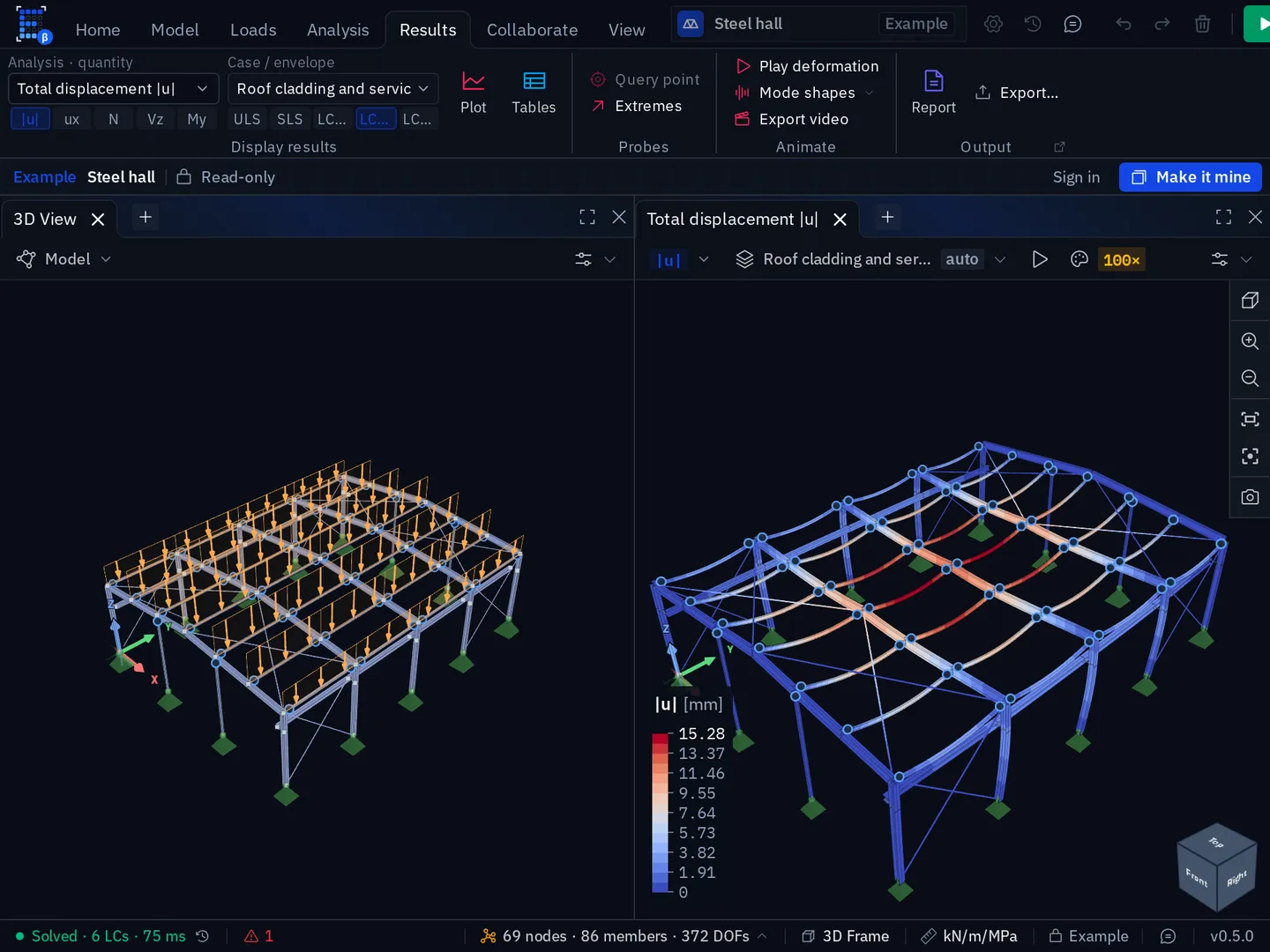
Steel hall
Steel · industrial
 Open this model
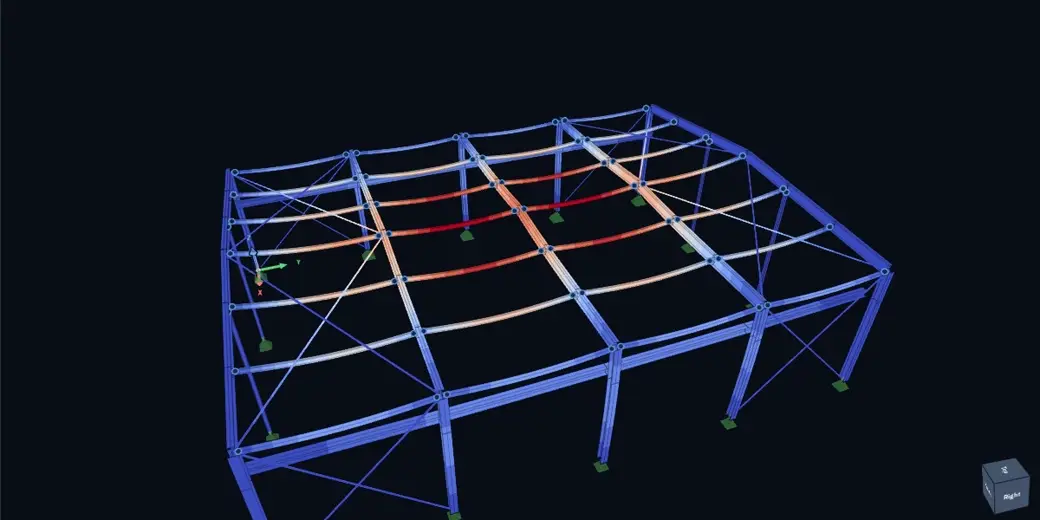
A four-bay portal hall, 18 × 24 m and 6 m to the eaves, with bracing and a 10 t overhead crane. The quickest way through the whole workflow.
What to look at
- 1 Six load cases in four groups, and the EN 1990 ULS and SLS combinations generated from them
- 2 Rigid arms carrying the crane runway off the columns, and bracing as bar elements among the beams
- 3 Two EC3 member checks, on the columns and the rafters, each tracing its utilisation to its clause
- 4 The frame's α_cr on every ULS permutation, with the purlins, struts and bracing marked Braces only, so the list of modes reaches the frame's own sway (α_cr ≈ 18.7, mode 11) instead of a purlin bowing on its own
- 5 Ten named groups, so selecting "Rafters" or "Wall bracing" is one click rather than a rubber band
- Nodes
- 69
- Members
- 86
- Free DoF
- 2,353
- Solve, 2nd run
- 52 ms
- Loads
- 6 load cases in 4 groups · 2 combinations
- Checks
- 2 EC3 checks
Over the free cap — solves here; your copy solves on Student or Pro
Read alongside
02 / 04
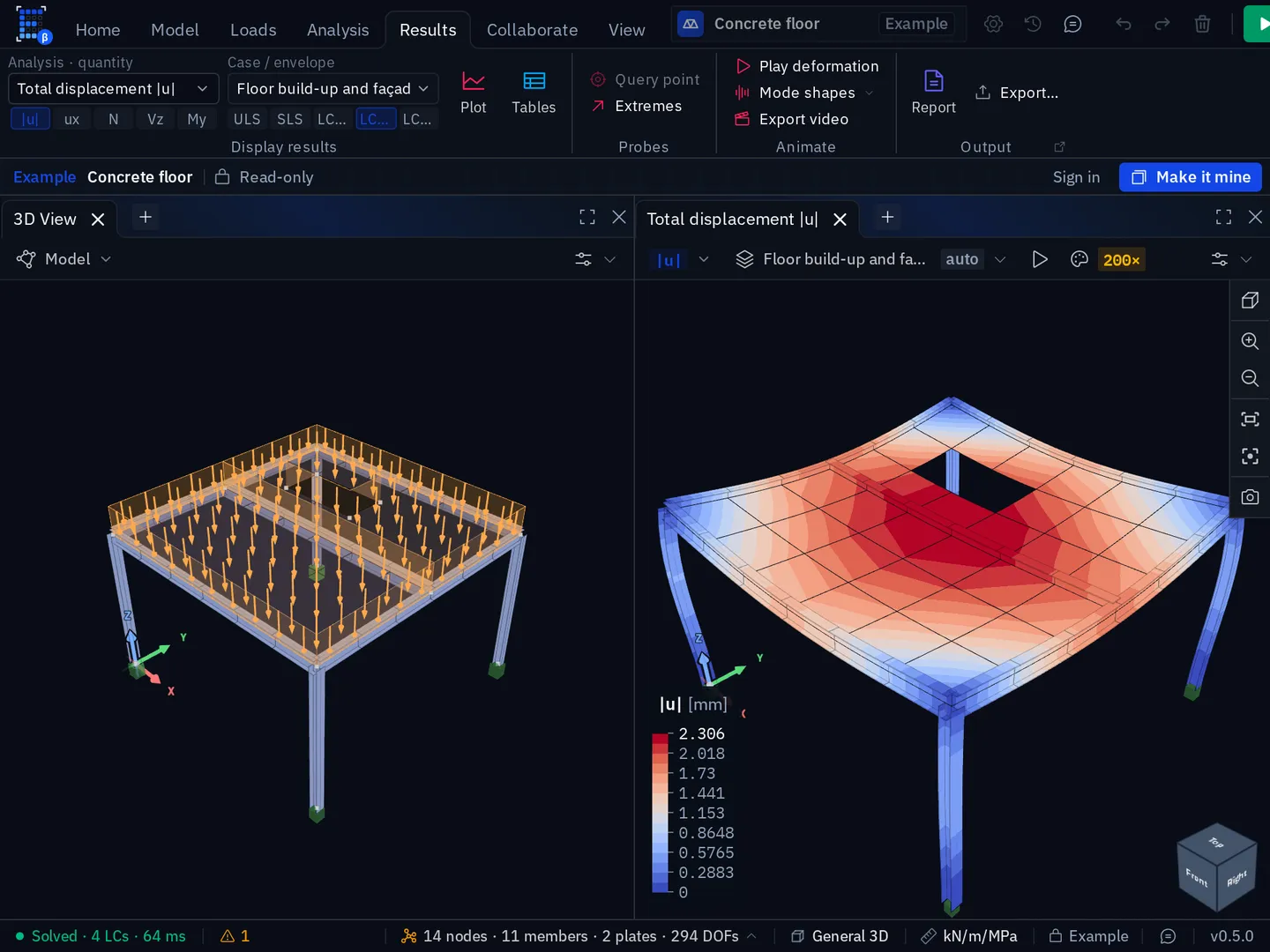
Concrete floor
Concrete + steel · buildings
 Open this model
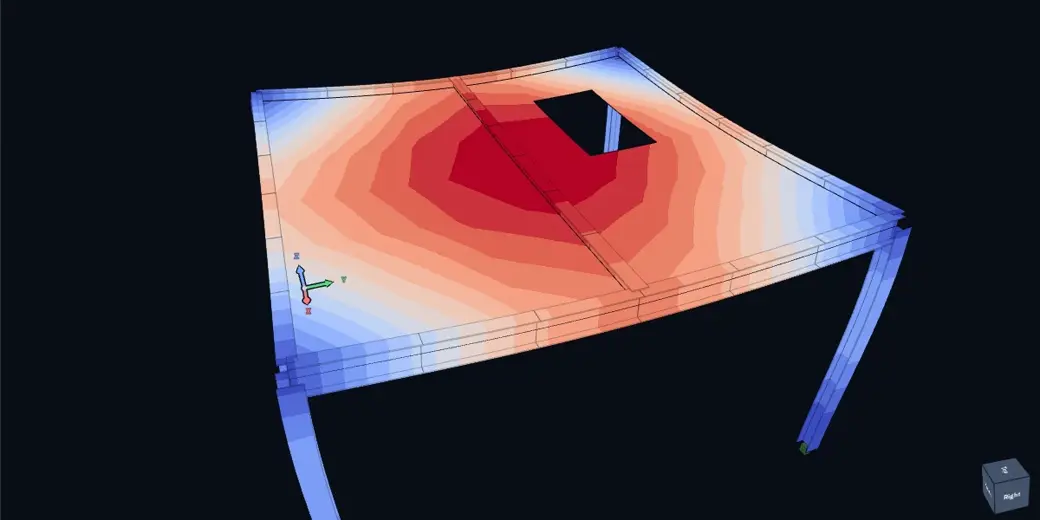
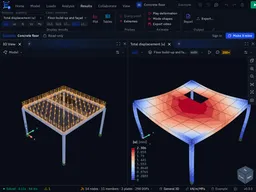
A 6 × 6 m floor bay: a 200 mm C30/37 slab in two panels on a steel frame, with a service opening. Open this one to see what surfaces do, and what happens where a shell meets a beam.
What to look at
- 1 Four-node shells meshed at 1 m, and what the opening does to the deflected surface
- 2 Two materials in one model, C30/37 in the slab and S235 in the frame beneath it
- 3 A pattern load: imposed over the whole floor, or over the far panel only, never both
- 4 A meshed slab whose copy fits the free plan: 337 DoF, because it is deliberately coarse at 1 m. At 0.25 m, fine enough for design moments, it is several thousand
- Nodes
- 14
- Members
- 11
- Free DoF
- 337
- Solve, 2nd run
- 36 ms
- Loads
- 4 load cases in 2 groups · 2 combinations
- Checks
- 1 EC3 check
Your copy has 663 DoF of headroom on Free
Read alongside
03 / 04
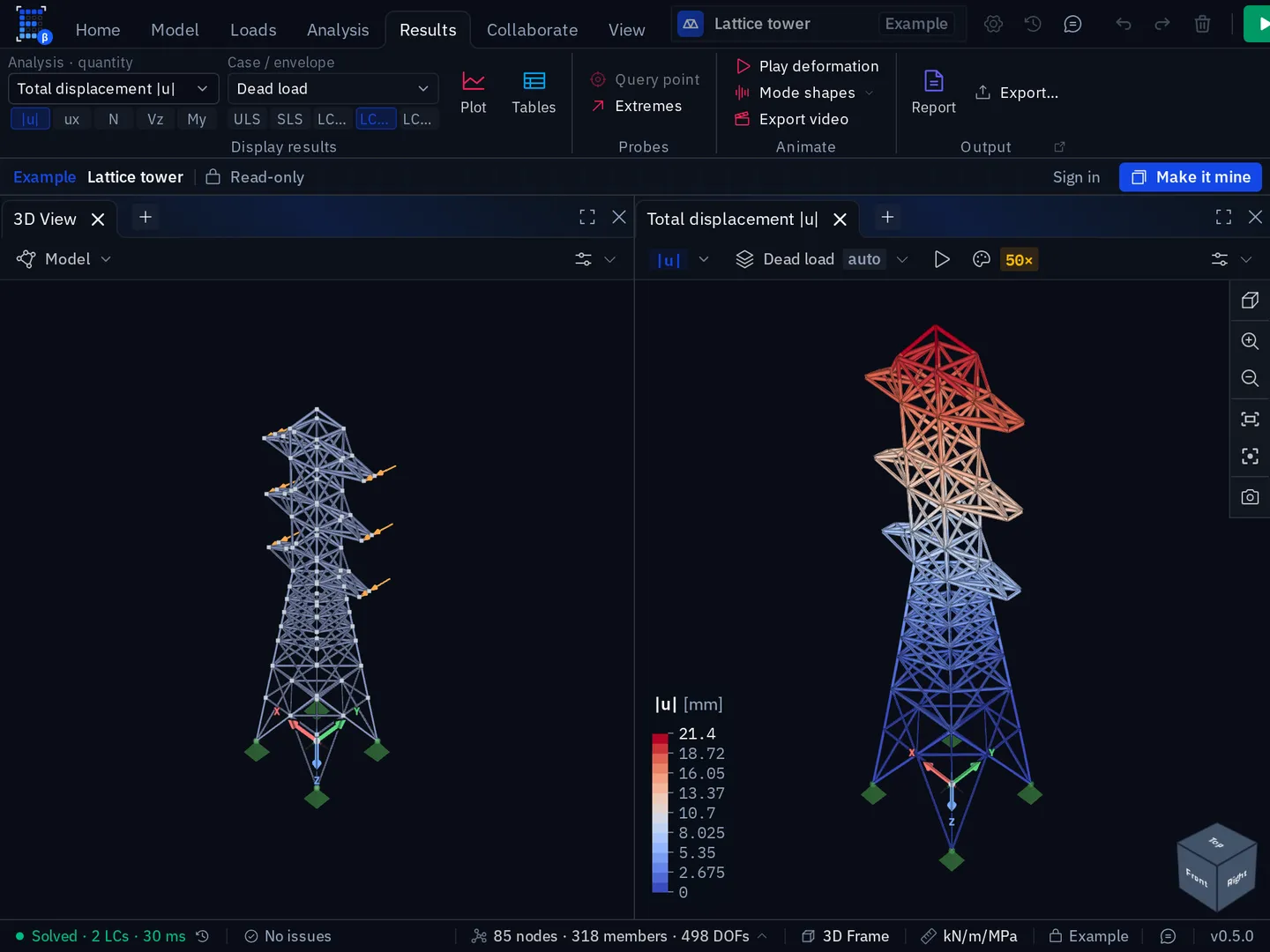
Lattice tower
Steel · lattice towers
 Open this model
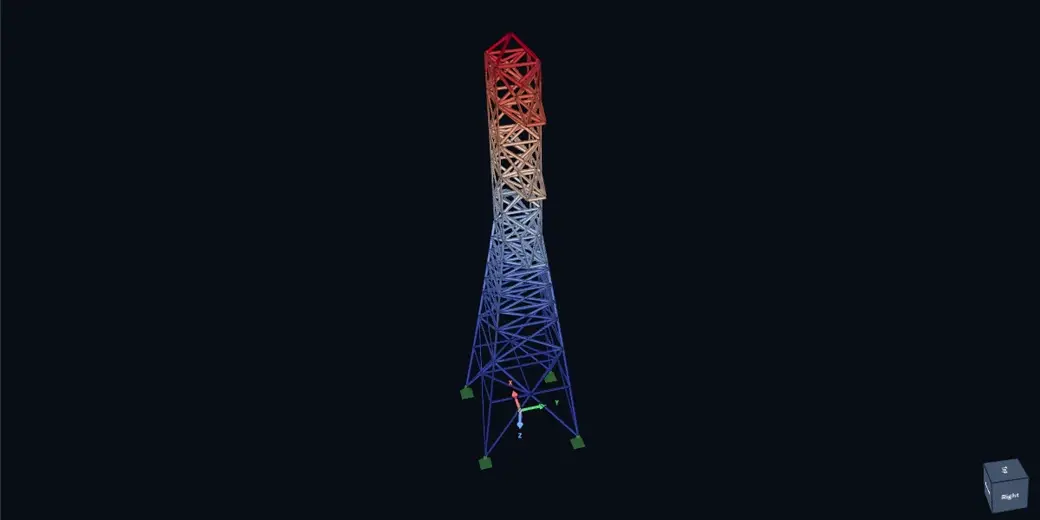
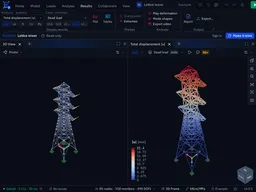
A four-legged transmission tower with crossarms: 318 members on four pinned feet. Open it to see how the editor handles hundreds of members.
What to look at
- 1 A full-size 3D lattice, 85 nodes and 318 members, redrawn and re-solved in under a third of a second
- 2 Conductor loads hung at the crossarms, and the sway that follows from them
- 3 Support reactions at each of the four legs, which is the number the footing designer actually asks for
- 4 A space truss of EN 10056 angles in five groups, each checked to EC3 with the connection it has: the legs concentric, the bracing and crossarms through one leg by Annex BB.1.2, every member verified
- 5 The frame's α_cr from a stability analysis, far above 10, so the first-order forces the checks read stand
- Nodes
- 85
- Members
- 318
- Free DoF
- 498
- Solve, 2nd run
- 38 ms
- Loads
- 3 load cases in 2 groups · 2 combinations
- Checks
- 3 EC3 checks
Your copy has 502 DoF of headroom on Free
Read alongside
04 / 04
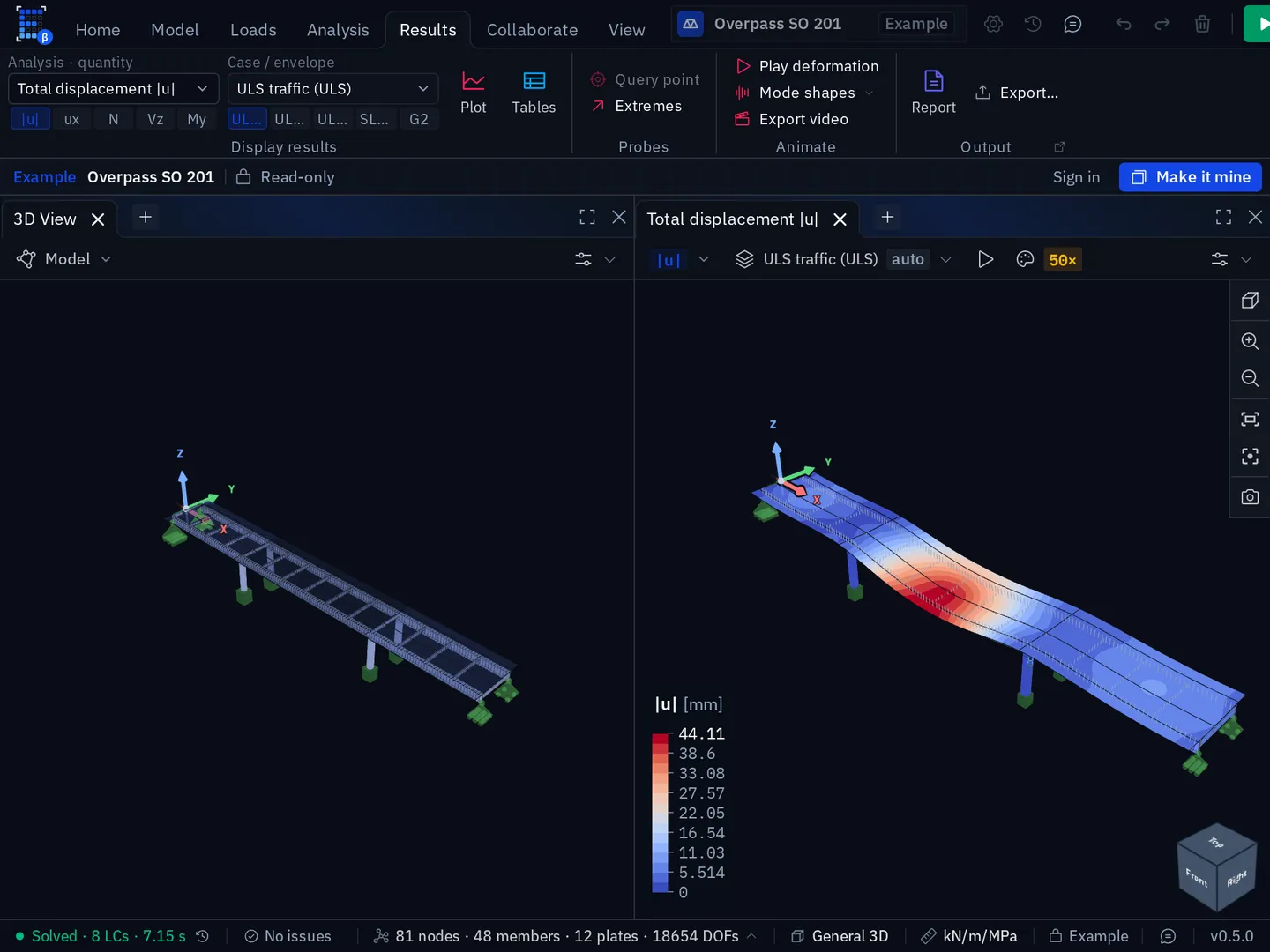
Road overpass
Bridges · road
 Open this model
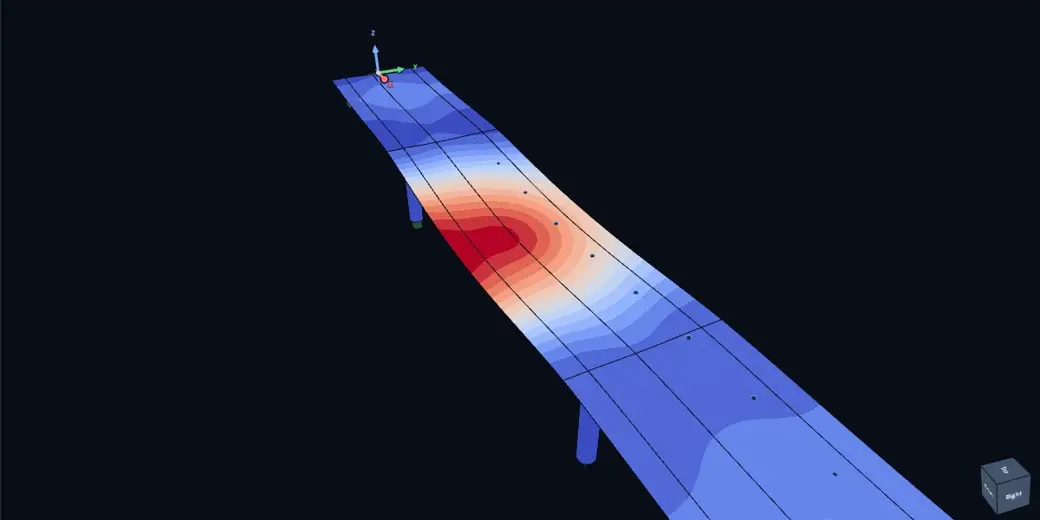
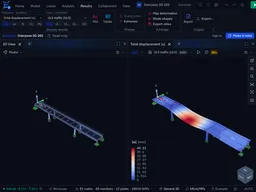
A three-span road overpass, 20 + 30 + 20 m: a 10.5 m, 250 mm C35/45 deck on two welded S355 girders, on twin-column piers, loaded to EN 1991-2 Load Model 1. The biggest model here, brought in from IFC.
What to look at
- 1 Composite action without a composite element: the girders hang 875 mm under the shell deck by member eccentricity
- 2 EN 1991-2 Load Model 1 lane by lane, with the tandem axles as point loads at mid main span
- 3 Bearings 150 mm under the bottom flange on rigid arms: fixed on pier 1, sliding on pier 2 and both abutments
- 4 A model written as an IFC4 file with IfcOpenShell and opened through the IFC importer
- Nodes
- 81
- Members
- 48
- Free DoF
- 91,302
- Solve, 2nd run
- 6.6 s
- Loads
- 8 load cases in 6 groups · 4 combinations
- Checks
- None set up
Over the free and student caps — solves here; your copy solves on Pro
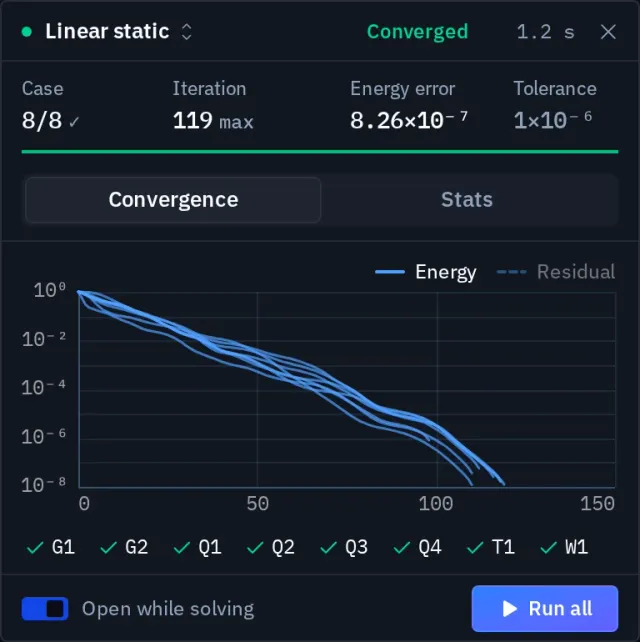
91,302 DoF and 8 load cases, solved in 6.6 s.
On your own cores, with no account. Press F5 and the solve monitor opens beside the model, with the iterations for each load case, the convergence chart and a Stop button.
Read alongside
Every example is a model, not a picture of one.
01
Open it
One click and the solved model is on screen, with no account. It is read-only, so you can't break it.
02
Make it mine
The button above the editor copies the example into your account. From there it's your model: change a load, move a support, solve again.
03
Take the file
Every example downloads as a .elproj file. File → Open reads it on any machine, signed in or not.
Bringing a model the other way? Use File → Import → IFC model or SAF spreadsheet. SAF, the Structural Analysis Format, stores a model in an ordinary .xlsx workbook, and many analysis and connection design programs exchange models in it too. The SAF specification ↗
The best example is your own model.
Take something you've solved elsewhere, export it as IFC or SAF, import it here and compare the answers.
Want an example we don't have?
A core, a raft, or a structure you doubt we can handle. An IFC or SAF file is the best request there is.
Suggest an example