Meshing
Mesh density, local refinement and the quality checks that tell you when a mesh is fine enough to trust.
Meshing 4 min read
Beams and bars need meshing for narrower reasons than surfaces do. Their formulation is exact for prismatic members under end loads and uniformly distributed load, so in a linear static analysis subdivision only affects where results are reported.
That exactness belongs to the elastic stiffness matrix alone. It does not carry over to stability or modal analysis, where the geometric stiffness and mass matrices are built from the same cubic shape functions but are approximations. A pin-ended column modelled as one element buckles at against the Euler value of (about 22% high); two elements bring it inside 1%. A one-element member also has no internal node, so it cannot represent a mode shape that has one. Tapered and curved members need subdivision in every analysis type, linear static included.
Both are controlled the same way: a global target for beams and a global target for surfaces, either of which can be overridden on an individual member or slab. Modal, stability and second-order analyses add their own minimum number of beam subdivisions on top. That minimum is a floor, not a default: a member you set to one element is still raised to what those analyses need, so a model meshed for a static run does not quietly under-resolve its mode shapes.
Surfaces are different: there the mesh is the approximation, and its density decides how much of the answer you get.
The mesher
Elementarium meshes surfaces with its own mesher, on your machine alongside the solver. It is all-quad, because the shell element is the only surface element and it is a four-node quadrilateral. That holds where the geometry is hardest — opening corners, re-entrant notches, skewed edges — which is where a mesher that fell back to triangles would put its worst element.
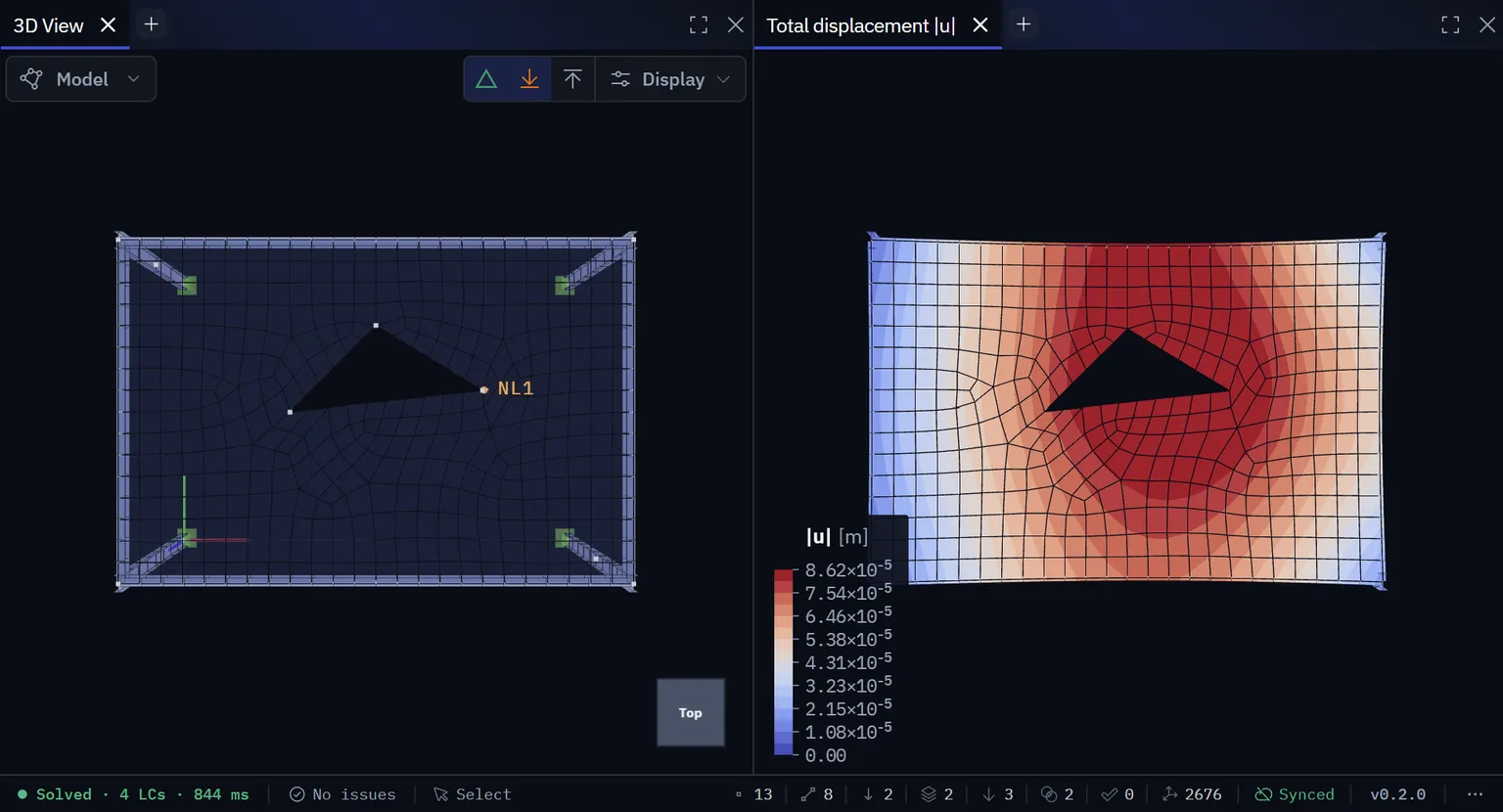
Discretisation is set globally and overridden locally. You give the model one target element size and one member subdivision count, override either on the slab or member that deserves it, and optionally cap the analysis element length across the model as a hard ceiling. The size field grows away from whatever asked for refinement at a gradient, not a step, so the transition is graded. Local refinement covers where that pays and where it does not.
One mesh, not two
Two connected slabs that share an edge share its node chain, because the curve is discretised exactly once. That shared chain is the connection, and it is stored with the plate rather than inferred from geometry — see How other things attach. The same mechanism attaches a rib crossing a slab or a beam running along its edge: the member is embedded in the slab's mesh and the two share one row of nodes, not two coincident rows that only look connected. Where a beam runs along a slab, the finer of the two subdivisions wins, because a beam cannot be coarser than the slab it stiffens without tearing off it.
In this section
- 01Choosing element sizeStarting mesh densities for slabs, walls and rafts, and the convergence test that decides whether a mesh is fine enough.
- 02Local refinementWhere to spend elements, where not to bother, and how to refine without wrecking element shape.
- 03Mesh qualityAspect ratio, skew and warping — what degrades a result, what the mesher reports, and how to tell whether the elements you are worried about matter.
The one idea to hold on to
A displacement-based finite element mesh is stiffer than the structure it represents. Refining reduces that artificial stiffness, so displacements increase and converge from below. Stresses have no such bound: peak stresses usually rise as the mesh is refined, so a coarse mesh under-reads them, and at a singularity they do not converge at all.
Typical starting densities
| Situation | Reasonable first mesh |
|---|---|
| Flat slab, deflection and global moments | 8–12 elements across the shorter span |
| Slab, local moments near columns | Elements of about the slab depth near the face; read the face moment, not the peak at the column centre |
| Shear wall, global behaviour | 6–8 elements across the length, 1 per storey minimum |
| Wall with openings | 4+ elements between the opening and the edge |
| Raft on elastic foundation | 10+ elements across the shorter dimension |
These are starting points. The answer comes from the convergence test.
What meshing does not fix
- Point loads and point supports produce genuine singularities in plate theory. Refining drives the local moment towards infinity. Use a patch, a finite bearing area, or read the moment at the face of the support instead of at the node.
- Re-entrant corners behave the same way. Model a realistic fillet or accept that the local peak is an artefact.
- Wrong boundary conditions are unaffected by mesh density. If the deflected shape looks wrong, refining gives you a more precise wrong answer.
Something wrong or unclear on this page? Tell us, and it gets corrected.