Serviceability checks
Deflection, drift and floor frequency checked member by member at SLS, to the national annexes, EN 1990:2023, IBC, AISC or EN 1995-1-1.
Design checks 7 min read
A strength check asks whether a member breaks. A serviceability check asks whether anyone will notice it working: a sagging floor that cracks the partitions on it, a cladding rail that lets the glazing rattle, a frame that sways enough to be felt. Elementarium checks three of these member by member, beside the strength checks, and reports each one the same way: the measured value, the limit, and the clause the limit comes from.
| Check | What it reads | Modules |
|---|---|---|
| Deflection | The member's own sag between its supports, or a cantilever's tip | EN 1990 with national annex presets · IBC Table 1604.3 · EN 1995-1-1 §7.2 with creep |
| Drift | The horizontal movement of a column over its storey and over the building height | EN 1990 · AISC 360 |
| Floor frequency | A floor beam's natural frequency, estimated from its deflection | SCI P354 · AISC Design Guide 11 |
Setting one up
Analysis → Design checks → Serviceability opens the project's serviceability check, or starts one if there is none. Pick the module, then the preset — the row of the code's table that describes the member — and the scope: which members, which combinations. Results appear in the Design checks table in the dock, next to any strength checks, and in a viewport's Design utilization plot.
A serviceability check is a design check like any other, so it counts towards the plan's design checks per project: one on Free, ten on a student account, unlimited on Pro.
Each limit on its own combination
EN 1990 does not ask one deflection to satisfy one limit. It writes several criteria for the same member, each read under a different serviceability combination, and the check keeps them apart:
| Criterion | Combination | Typical reading |
|---|---|---|
| Damage to non-structural elements | Characteristic | The deflection that arrives after the partitions and finishes are fixed |
| Comfort | Frequent | The variable part, as people feel it |
| Appearance | Quasi-permanent | The long-term total, net of precamber |
Each criterion runs only on combinations of the type it was written for. A combination you build by hand carries no type, so every criterion is checked on it. Generated combinations carry their type from the generator — see Load combinations.
The ASCE 7 service combinations the generator writes are D + L, D + (Lr, S or R), D + 0.5L and D + 0.5L + 0.42W.
Deflection
What is measured
A span limit is a limit on the member's own bending. So each stretch between supports is measured from the chord through its displaced ends, the way EN 1990 Figure A1.1 draws it. A beam sitting on a girder that sags 10 mm does not inherit those 10 mm; the girder's own check does.
A cantilever is measured from its support's displaced position, parallel to the undeformed axis. The support's rotation is therefore part of the tip deflection — often the larger part, when a back span lifts — and that total is what the tables were written against when they double a cantilever's length.
Each limit reads one component of the deflection, re-superposed from the load cases of the combination with the others left out:
| Component | Meaning | Where it appears |
|---|---|---|
| Total | Every case of the combination | EN w_tot, EN 1995 w_inst |
| Total net of precamber | The total minus the member's precamber | EN 1990 w_max |
| Variable actions | The variable cases only | EN 1990:2002 w₃, EN 1990:2023 w₂ + w₃, ČSN δ₂, UK NA |
| One variable action | The worst single variable action | DS/EN 1993-1-1 DK NA |
| Live / Snow or wind | L or Lr; S or W | IBC Table 1604.3 |
| Creep part of D + L | IBC footnote d |
It is never the difference of two combinations. Subtracting a "dead only" result from a total goes wrong as soon as the two were factored differently.
The peak is read between the solver's stations by fitting a parabola through the three samples around the largest one, which is a better estimate of a smooth maximum than the sample beside it.
Presets
| Module | Presets from | Examples |
|---|---|---|
| EN 1990 · Deflection (SLS) | ČSN EN 1993-1-1 NA.2.22 Tab. NA.1 (CZ) · NA to BS EN 1993-1-1 NA.2.23 (UK) · NF EN 1993-1-1/NA Tableau 1 (FR) · PN-EN 1993-1-1 NA Tabl. NA.1 (PL) · DS/EN 1993-1-1 DK NA 7.2.1(1)B (DK) · NEN-EN 1990/NB A1.4.3 (NL) · EN 1990:2023 A.1.8.2.2 Tab. A.1.10 | CZ purlins δ₂ ≤ L/200, floor girders L/400; UK brittle finish L/360; EN 1990:2023 floor with non-brittle partitions w_max ≤ L/400, comfort L/300, appearance L/250 |
| IBC 1604.3 · Deflection (SLS) | IBC 2021/2024 Table 1604.3 | Floor members L/360 under live load, L/240 under D + L |
| EC5 · Deflection with creep (SLS) | EN 1995-1-1 §7.2, Table 7.2 | Timber members: , and , with the service class and |
The EN 1990 module checks steel and aluminium; EN 1995 checks timber. Where no national preset is chosen, the EN 1990:2023 values apply. Custom takes your own , an absolute cap in millimetres, a cantilever factor (2 by default) and whether precamber is subtracted.
What the member tells the check
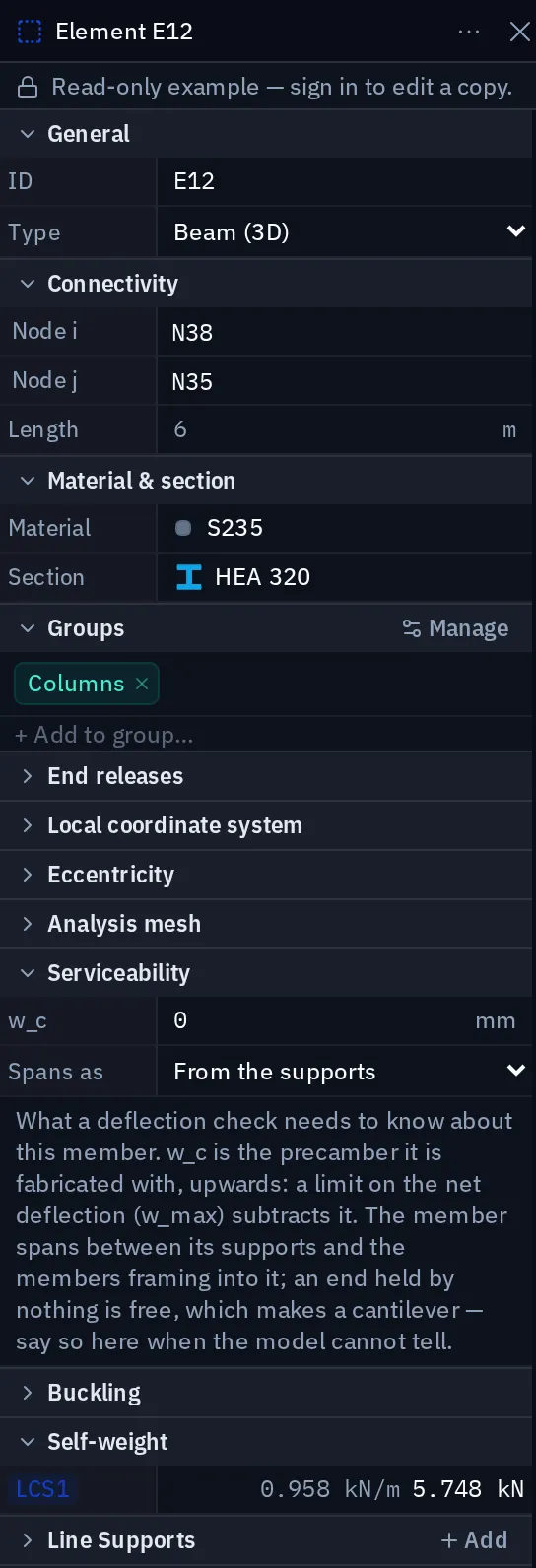
Select a member and open Serviceability in the Properties panel:
- w_c — the precamber the member is fabricated with, upwards. A limit on the net deflection subtracts it.
- Spans as — From the supports (the default: the check finds the stretches between supports itself), Span (held at both ends), or Cantilever — fixed at the start node / end node when the model's supports alone would not say so.
Drift
Read per column member, which is what a member-based check can say without inventing storeys:
- Storey drift — the horizontal part of the column's top-minus-bottom displacement over its height. For a column one storey tall that is exactly EN 1990's .
- Overall drift — the horizontal displacement of the column's top over its height above the foundation. At the top storey that is the building's .
The horizontal displacement is the resultant of both directions, so it is never smaller than an X-only or Y-only reading. EN 1990 · Horizontal drift carries the CZ, UK, FR, PL and DK annex tables and EN 1990:2023 Table A.1.11 (by default H/500 overall and h/200 per storey under characteristic combinations); AISC 360 · Drift offers h/400, h/500 or h/600 after AISC 360-22 Commentary L3 and ASCE 7 CC.2.2.
Floor frequency
A screen, not a comfort verification. It estimates a floor beam's fundamental frequency from its deflection under the load actually present in service:
Both are the same physics — a uniformly loaded simple beam gives — and both take δ as the absolute deflection, supports included, because a beam on flexible girders really does have a lower floor frequency than on rigid ones. The permanent load counts in full and a share of the imposed load (10 % for the EN module, 20 % for AISC) is added; the floor must reach , 3 Hz by default.
Reading the results
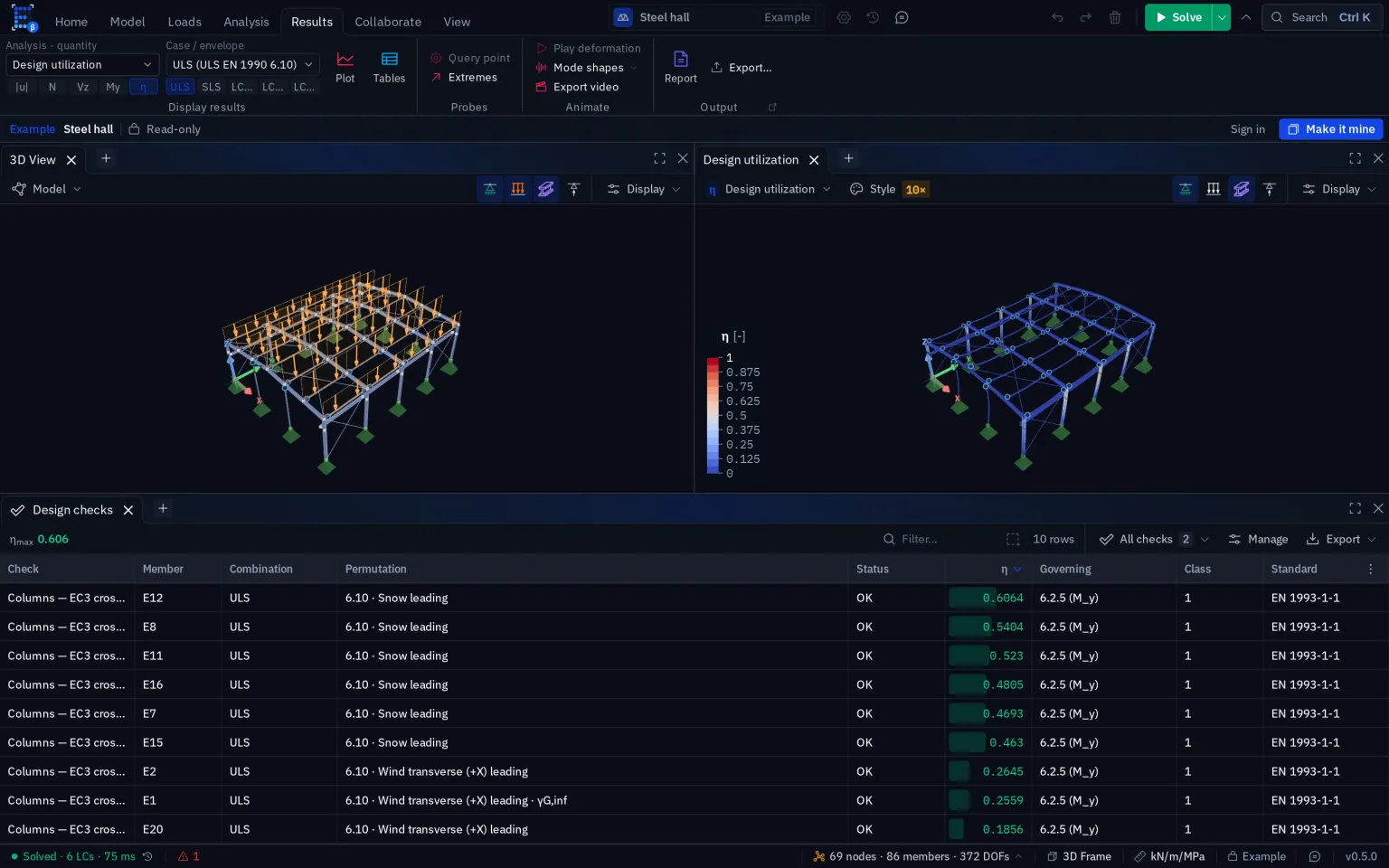
Serviceability rows sit in the same Design checks table as the strength rows, and read Measured against Limit in place of the section class — a deflection in millimetres beside the it is held to, worked out for that span — with η their ratio. Expand a row for the criterion, the combination, the component of the deflection it read and the position along the member; the calculation sheet and the report carry the same trace.
What is not checked
- Floor acceleration and response factor — see above.
- Crack widths and concrete deflection — there is no concrete module yet; EN 1992 serviceability arrives with it.
- Plates. The checks read members. A slab's deflection is read off its contour against the limit you choose; see Linear static analysis.
- Ponding and long-term effects other than timber creep.
Related
Design checks explains how every check reports itself and why each is versioned; Load combinations how the characteristic, frequent and quasi-permanent combinations are generated.
Something wrong or unclear on this page? Tell us, and it gets corrected.