Spreading a point load
A point load on a plate acting over a rectangle or circle, dispersed at 45° to the mid-plane (EN 1991-2 §4.3.6), so the moment under it converges.
Loads & combinations 2 min read
A point load on a plate is a finite force on zero area. The moment under it grows every time the mesh is refined: it is a singular point. Real loads arrive over an area, such as a wheel's contact patch, a post's base plate or a machine foot. Giving the load that area makes the result under it converge.
What it does
The load acts over a rectangle a × b or a circle of diameter d at the surface. That area is dispersed at an angle φ, through any surfacing and then through half the slab, down to the slab's mid-plane, where the plate carries it:
with the surfacing thickness and the slab thickness. The same widening applies to and to . The default angle is 45°, as EN 1991-2 §4.3.6 gives for wheel loads.
The forces then act as a pressure over the dispersed area, and the total force stays exact. A moment applied at the node stays at the node.
For example, a 0.4 × 0.4 m contact patch on 80 mm of surfacing over a 250 mm slab spreads to m square at the mid-plane.
Measured
- as a point load
- spread over 0.4 × 0.4 m
| |mₓ| under the load, kNm/m | h = 0.2 m | h = 0.1 m | h = 0.05 m | last halving |
|---|---|---|---|---|
| as a point load | −4.10 | −4.78 | −5.45 | +14.0 % |
| spread over 0.4 × 0.4 m | −3.19 | −3.45 | −3.47 | +0.6 % |
As a point load, the moment under it rose by 14 % on the last halving of the element size and would keep rising. Spread over its area, it changed by 0.6 %.
When to use it
- Wheel and axle loads on a deck or a parking slab, where the code gives the contact area and the dispersion.
- Posts, props and machine feet standing on a slab.
- Any point load whose local moment you intend to read. If you only need global results, such as reactions, deflection away from the load or moments elsewhere, a point load is fine as it is.
A column standing on a slab can carry its load the same way, but if the column is in the model, a column head is the better tool: it also makes the column's end moment independent of the mesh.
Setting it up
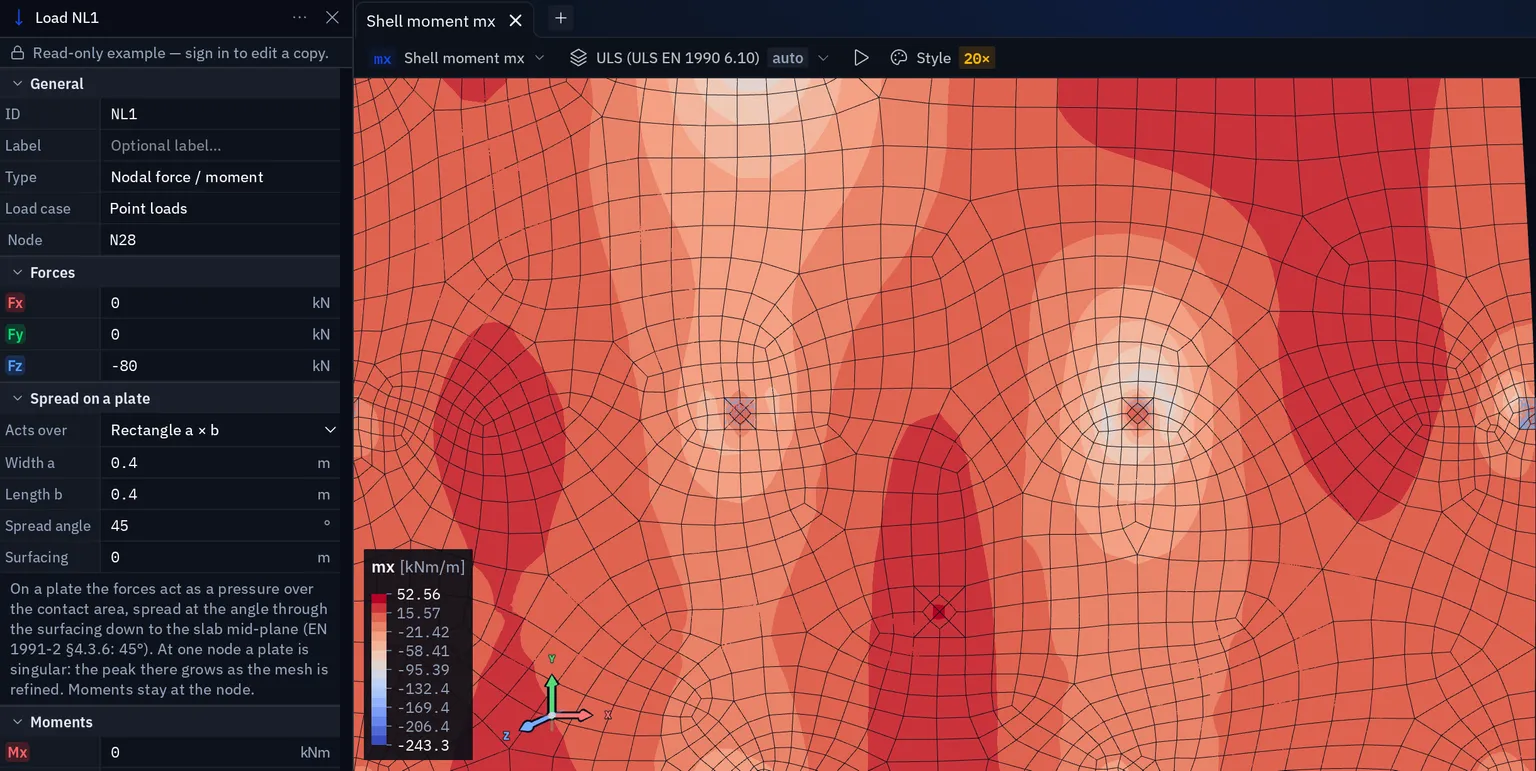
Select a nodal load on a plate and open Spread on a plate in its properties. The section is there for nodal loads only, and stays collapsed until a spread is set.
| Field | Values | Default |
|---|---|---|
| Acts over | The node, Rectangle a × b, Circle d | The node |
| Width a, Length b | Contact dimensions at the surface, for a rectangle | 0.4 m |
| Diameter d | Contact diameter at the surface, for a circle | 0.4 m |
| Spread angle | Dispersion angle φ | 45° |
| Surfacing | Thickness of the layers above the slab, in m | 0 |
Turning it off
Set Acts over back to The node. The load acts at one node again, and the singular marker under it returns.
Something wrong or unclear on this page? Tell us, and it gets corrected.