Elementarium 0.8.2: haunches, cold-formed purlins, fire and warping torsion
Haunched and tapered members, cold-formed C and Z purlins and steel in fire, each held to printed worked examples, and warping torsion on by default — plus ribs that no longer step at every node and reports written out as hand calculations.
0.8.2 went out on 11 November. Most of it is steel: three design checks for members the EN 1993-1-1 check could not take, a haunched rafter, a cold-formed purlin and a member in fire, and warping torsion in the analysis, which changes how open sections twist in existing projects too. This post goes through each, with the printed examples we checked them against. The release notes have every line.
Warping torsion, on by default
I, H and channel members now carry torsion as they really do: by warping as well as by St. Venant shear. They get a seventh degree of freedom, the rate of twist, and the results add the bimoment , the St. Venant and warping torques and the warping stress , in plots, tables and checks. Closed sections, tees, angles and solid bars stay St. Venant, because for them that is the whole story.
How each end of a member is tied for warping is set in Properties › Warping. By default warping runs on along a straight member of the same section and is free at knees, apexes, beam-to-column joints, supports and free ends, which is the conservative side. An end can be fixed, sprung, or tied through a joint by box or diagonal stiffeners. See Torsion.
The EN 1993-1-1 check reads the bimoment. An open I or channel is verified by §6.2.7(4) and (5), with beside , and at the section's critical points. Member stability has no rule with torsion in §6.3, so a bimoment under , the line EN 1993-1-1:2022 C.2(6) draws, is left out of it and the result says so. Past that line the member's stability reads not verified, unless the check takes EN 1993-6 Annex A (A.1) for a simply supported member with no axial force.
This changes results in existing projects. An I, H or channel member twists and carries torsion differently from the six-DOF member it was, and its check now reads the bimoment. Project settings › Model › Torsion of open sections › St Venant goes back.
Haunched and tapered members
A member can now deepen towards either end over a length you choose, or along its whole length. Set it in Properties › Haunch, one line per end, or drag the haunch's length in the member's side view. At each end the haunch runs to the member's own section deepened to a depth you state, or to another section you name. Rectangular sections take a haunch too. An I or H haunch is solved with a tapered element built from its plates.
§6.3.1 to §6.3.3 of EN 1993-1-1 are written for uniform members, so a haunched steel I has its own check:
- §6.2 at every station, on that station's own section and in its own class. The web deepens along the member, and its class can change with it.
- §6.3.4, the General Method, for the member. comes from the tapered member's own lateral-torsional eigenvalue, which keeps the terms from the sloping flanges that a chain of prismatic pieces drops.
- Stable lengths by Annex BB.3, next to plastic hinges or for purlins on the tension flange, when the check asks for them.
Checked against ECCS worked example 4.2, a welded I tapering from 360 to 200 mm over 7 m, forked at both ends, under 80 kN of compression and 12 kN/m at the shear centre: the check finds the printed critical section, = 1.819 and = 1.482 to within 1 %, and the same failing (6.63).
Cold-formed C and Z purlins
The new EN 1993-1-3 check takes a Cold-formed C / Z section from the section editor, plain or lipped, and works on its effective section: local buckling of each flat part, and distortional buckling of each lipped flange as an edge stiffener on a spring, Steps 1 to 3 of §5.5.3.2. Then cross-section resistance by §6.1, the web under every support and load that reaches it across a flange included, and member buckling by §6.2.
Tell a member which flange the sheeting is fastened to and it becomes a purlin by §10.1. The check reads whether the sheeting holds that flange, (10.1a), from its shear stiffness where you give it, and then the free flange: its lateral bending from Table 10.1 and, where it is compressed, its buckling by (10.7). That covers single spans and the end and inner spans of a continuous purlin, under gravity and uplift. A Z is checked only this way, since its principal axes lean off its web.
The effective sections reproduce the printed steps of the JRC's lipped channel 150 × 47/41 × 16 and of Access Steel SX022a and SX023a, a 200 × 74/66 × 20.8 channel in bending and in compression. Where a print leaves out rounded corners that §5.1(3) counts, the check counts them. What the check does not cover reads not verified and says why: torsion, a purlin overhanging its support, a span under a point load.
Steel in fire
The EN 1993-1-2 check verifies a carbon steel I, H or box member in a nominal fire for the R you require. It heats the steel second by second, unprotected by (4.25) or behind protection by (4.27), on the standard, external or hydrocarbon curve. It then takes the resistances of §4.2.3 at the temperature reached, and solves the critical temperature on Table 3.1 with the time it takes to get there. The forces are , with = 0.65 unless you set another.
We held it to eleven printed worked examples from the JRC and the SCI. One runs through the whole check: JRC EUR 26698 Example 1, an IPE 360 secondary beam in S275 over 7 m, held by its slab, 14.105 kN/m in the fire situation.
| Result | ||
|---|---|---|
| Unprotected, four sides | 667 °C, reached at 17 min | R15 holds, R30 does not |
| Sprayed 10 mm, three sides | 687 °C | 631 °C at 60 min: R60 holds |
The accidental combination (6.11b) is not generated, which is why the forces go through , and stainless steel in fire is not covered.
Any steel section you draw or build up
A section drawn on the editor's canvas, or built up from plates, can now be checked to EN 1993 and to AISC 360. EN 1993-1-1 classifies it plate by plate by Table 5.2, under the forces at each station, on its principal axes, and verifies a Class 4 one on its effective section by EN 1993-1-5 §4.4. See Section classification.
Also new
Ribs and beams on slabs no longer step at every node. A member tied to a slab along its length takes the slab's shear only at the nodes they share, so its own forces stepped at each one. They are now drawn through each element's midpoint value, and the steps that are real stay where a support, a load or another member acts. Smooth members on slabs switches it off. See A member's own forces on a slab.
Stability reads the frame's sway mode. In a hall the lowest modes are often a purlin or a brace buckling on its own. The buckling analysis now picks out the mode in which the frame sways, and purlins and bracing can be marked Braces only so their own buckling stays out of it.
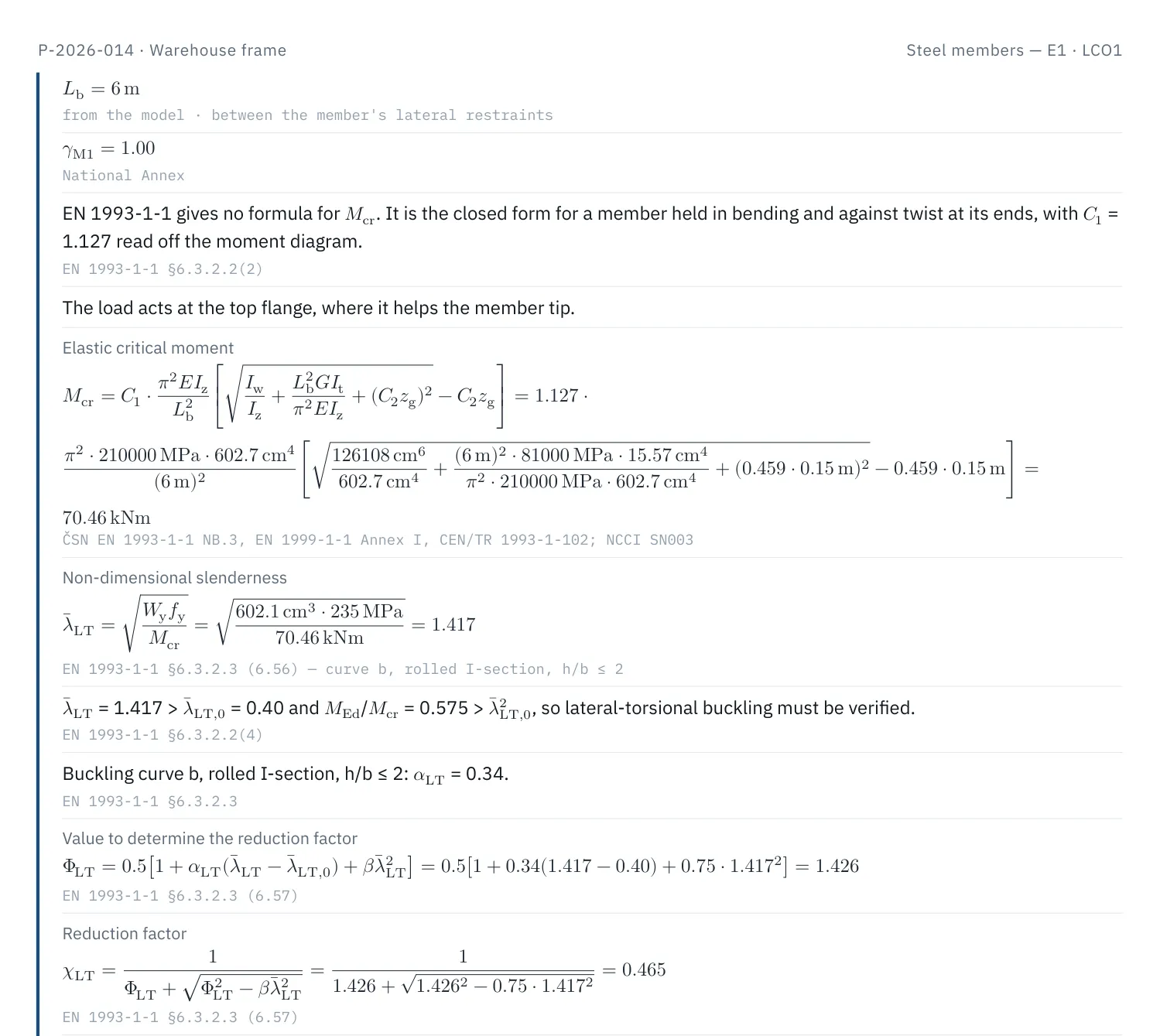
Reports read as hand calculations. Each check is written out step by step: a sentence with its clause, then the formula with your numbers in it. The model figure is drawn as the viewer shows it, and subscripts stand upright, as the Eurocodes print them.
The smaller things: a parts list with a material take-off and prices; project and app settings rebuilt, with search; member and surface loads drawn on the face they push on; and a wind and snow generator that describes the building as a hand calculation does.
Look over your steel checks
This release carries another round of corrections across the steel checks, against the code texts. Like every correction, they reach existing checks, pinned versions included (see Module versions). With warping torsion on by default as well, look over the results of your steel projects again, starting with open sections under torsion.
The examples open without an account. If a check disagrees with your hand calculation, send us the project at [email protected].